If you have OCD, you may find yourself constantly seeking reassurance — from a partner, parent, friend, doctors, Google, or even your own memory.
Did I hit someone while driving
Are you sure I turned off the stove
I need to review that conversation to make sure I didn’t say something offensive.
Reassurance feels comforting in the moment. It can bring immediate relief and calm your anxiety temporarily.
But over time, reassurance strengthens OCD.
Reassurance is actually a compulsion — and like all compulsions, it keeps the OCD cycle going.
What Is Reassurance in OCD?
Reassurance is a very common compulsion in Obsessive Compulsive Disorder (OCD). It’s done to reduce the distress caused by an obsessive thought or obsession.
For example:
If you have an obsessive fear that your medication was poisoned, you might repeatedly ask your partner, "Are you sure it’s safe?"
If you fear you hit someone while driving, you may ask for confirmation that nothing happened.
Other examples of Reassurance include:
- Asking others to confirm you’re safe
- Replaying events in your mind
- Googling symptoms repeatedly
- Checking your feelings to make sure they are "right"
- Mentally reviewing conversations
- Comparing memories for certainty
Reassurance can be external (asking someone directly) or internal (mentally reviewing, checking, or arguing with yourself).
Reassurance can be a Mental Compulsion
Many people think compulsions only include visible behaviors like checking locks or washing hands. But mental compulsions including reviewing, analyzing, and self-reassuring are just as powerful.
Common mental reassurance compulsions include:
-
I would never do that.
-
I just need to think this through one more time.
Even though it happens internally, it functions as a compulsion and makes OCD stronger.
How Reassurance Strengthens OCD
Like other compulsions, reassurance can provide anxiety relief in the short run. However, in the long run reassurance leads to an increase in anxiety and OCD thoughts/obsessions, keeping you stuck in the OCD cycle. Because reassurance temporarily relieves anxiety, you continue to have urges to ask for reassurance the next time obsessions show up. The OCD cycle causes tremendous suffering, and compulsions can become time-consuming and interfere with daily life.
Each time you seek reassurance, your brain learns:
- The thought is dangerous
- You cannot trust yourself
- Anxiety must be eliminated immediately
The next time the obsession shows up, your brain sends an even stronger urge to seek reassurance.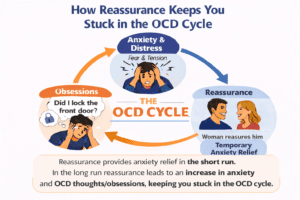 For example:
If you fear you didn't lock your front door and your partner reassures you that you did, you may feel immediate relief. But the next time you leave home, the doubt returns — often stronger — along with a powerful urge to ask again.
This is how the OCD cycle grows.
Over time, reassurance-seeking can become time-consuming and exhausting. It can strain relationships and shrink your world.
How ERP Helps Break the Reassurance Cycle
Exposure and Response Prevention (ERP), is a gold standard treatment for OCD.
ERP helps you:
- to delay and resist reassurance
- to tolerate your anxiety
- Allow anxiety to rise and fall naturally
- Build confidence in your ability to handle doubt
Instead of trying to eliminate anxiety, ERP teaches you that you can survive it — and that you don’t need reassurance to be safe.
Over time, the urge to seek reassurance weakens. Anxiety becomes more manageable. OCD loses its power.